AI User Tools
A self-initiated product exploration for an AI-powered audience simulation tool that lets early-stage founders validate ideas against synthetic personas before spending real money on real users.
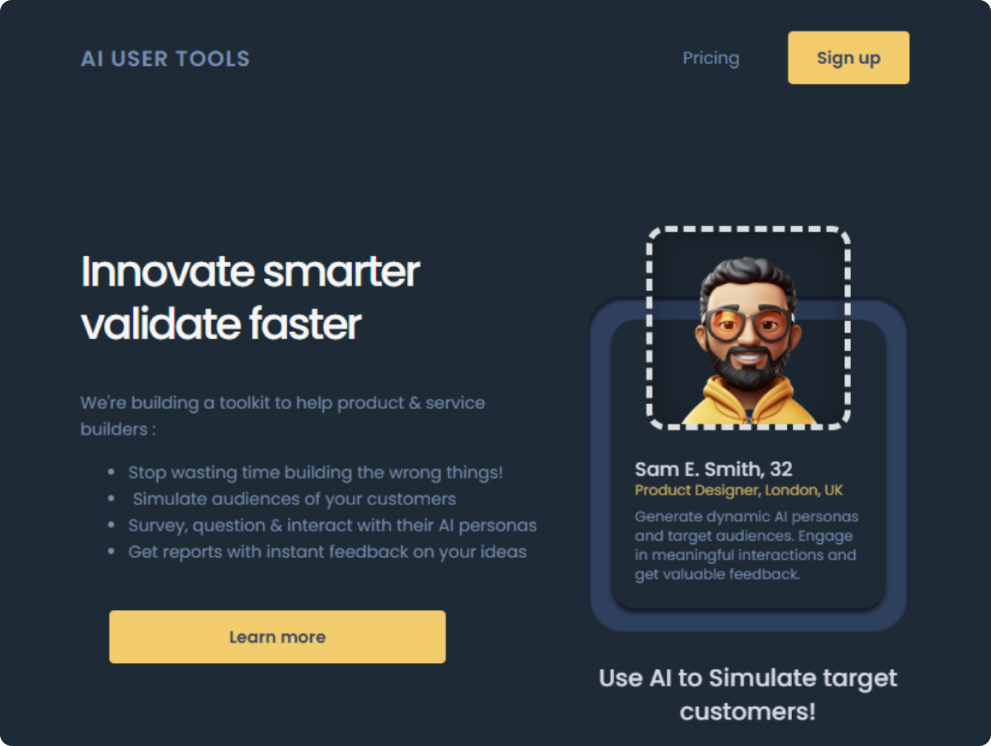
Early-stage founders waste months on things nobody wants because real user research is slow, expensive, and gated by recruiting. This was an exploration of what a GPT-powered audience simulation product could look like: strategy on the canvas, MVP scope, a working no-code proof of concept, and a landing page direction.
Solopreneurs, indie hackers, and small product teams in the pre-validation phase who would not commission a real research project but would pay a small monthly fee for a fast, directionally correct sanity check before committing hundreds of build hours.
Open self-set brief with no client to push back, a product category that barely existed (requiring invented vocabulary: audiences, modes, synthetic surveys, idea score), and messaging that had to be honest about synthetic-vs-real without undercutting the value.
Self-initiated concept work. The output was a defended product shape, an MVP scope, a working no-code proof of concept, and a landing page direction. Engineering never followed; the case study is the thinking, not a launch.
Strategy first (mission, market sizing, JTBD mapping, problem-vision-use-cases), then product shape (core loop diagram, feature brainstorm, MVP cut, modes system, wireframes, 12-month roadmap), then a Webflow + Zapier + ChatGPT POC to confirm the loop works, then a landing page with multiple hero variants ready to A/B.
A complete product exploration end to end: market thesis, JTBD-grounded feature set, MVP scope, working proof of concept, and a landing page with a defended point of view. The artefact set demonstrates moving from an open brief to a buildable product without skipping the strategy.